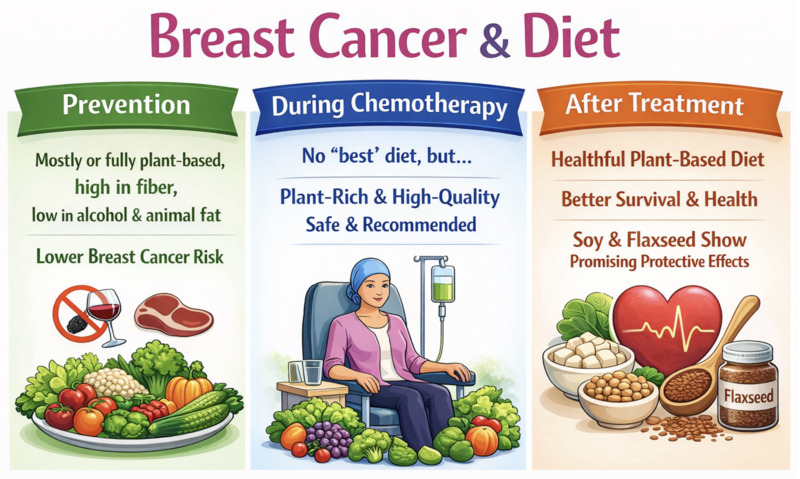

Diet and Breast Cancer
Prevention, During Chemotherapy, and After Treatment
(For education only; patients should discuss diet changes with their oncology team.)
Diet is not the sole determinant of breast cancer risk or outcomes, but decades of research show that dietary patterns rich in whole plant foods—fruits, vegetables, whole grains, beans, nuts, and seeds—play a meaningful role in prevention, overall survival, metabolic health, and possibly recurrence reduction.
Leading cancer researchers, epidemiologists, and organizations such as the World Cancer Research Fund (WCRF) and the American Institute for Cancer Research (AICR) consistently conclude that diets emphasizing whole plant foods, combined with low alcohol intake and healthy body weight, offer the strongest protection against breast cancer.
1. Diet and Prevention: What the Evidence Shows
Plant-rich dietary patterns and breast cancer risk
Large observational cohorts suggest that women who eat predominantly whole plant foods, maintain a healthy body weight, and limit alcohol intake have substantially lower breast cancer risk.
- In a pooled analysis reviewed by AICR, women who adhered most closely to cancer-prevention guidelines—including a plant-forward diet—had about a 62% lower risk of breast cancer compared with women who did not adhere (WCRF/AICR Continuous Update Project).
- A prospective cohort of over 91,000 women found that those whose diets centered on plant foods—vegetables, fruits, legumes, nuts, and whole grains—had a roughly 15% reduction in breast cancer risk, with stronger protection for estrogen receptor–negative tumors (UCSF analysis of the NHS II cohort; Fung et al., 2014).
- Case–control studies have repeatedly shown that women who consume four or more servings of vegetables daily or regularly eat legumes (beans, lentils, chickpeas) have about half the odds of developing breast cancer compared with those with low intake (Adebamowo et al., 2005; Shannon et al., 2003).
Specific whole-food components with evidence
- Dietary fiber: Low fiber intake is associated with elevated circulating estrogen levels, a known risk factor for breast cancer. High-fiber diets from whole plant foods consistently correlate with lower risk (Bernstein et al., 2005).
- Soy foods: Across multiple cohorts of both survivors and cancer-free women, moderate soy intake is linked to reduced risk, including a 29% reduction in breast cancer–specific mortality and 36% lower recurrence among survivors consuming the most soy versus the least (Shu et al., 2009; Zhang et al., 2017).
- Beans, lentils, and chickpeas: These foods are repeatedly identified as protective due to their fiber, phytonutrients, and anti-inflammatory properties (Adebamowo et al., 2005).
- Cruciferous vegetables and flaxseed: These foods contain glucosinolates, lignans, and other compounds shown in mechanistic and human studies to support estrogen metabolism and reduce oxidative stress (Fowke et al., 2007; Thompson et al., 2005).
Summary for prevention
The evidence is strongest for a diet that is:
- Mostly or fully whole-food, plant-based
- High in fiber
- Low in processed meat, animal fat, and alcohol
This pattern most consistently aligns with reductions in breast cancer risk across populations.
2. Diet During Chemotherapy: What We Know and What We Don’t
There is no single proven “best” diet during chemotherapy. However, major cancer organizations—including AICR and WCRF—recommend that patients follow essentially the same dietary principles used for prevention: more whole plant foods; fewer processed foods, meats, and added sugars.
What the scientific evidence suggests
Research on diet during chemotherapy is evolving. A high-quality, plant-predominant diet appears safe and may support treatment tolerance, metabolic health, immune function, and overall well-being.
Randomized controlled evidence
One of the most informative trials is the LEANer Study (Sanft & Irwin et al., 2023):
- Women with stage I–III breast cancer receiving neoadjuvant chemotherapy were randomized to a nutrition + exercise intervention vs standard care.
- The dietary component emphasized a predominantly plant-based pattern: ≥5 servings of fruits/vegetables daily, ≥25 g fiber, limited alcohol, sugar, and processed foods, and ≤18 oz/week red meat.
- The intervention group improved diet quality and physical activity.
- Both groups maintained excellent chemotherapy completion rates (~93%).
- In certain subtypes (hormone receptor–positive/HER2-negative and triple-negative), the intervention group showed higher pathologic complete response rates—an encouraging, though preliminary, finding.
Fasting-mimicking or restricted diets
Several early-phase studies have explored intermittent energy restriction or fasting-mimicking diets as adjuncts to chemotherapy. While some preliminary findings are intriguing, these approaches remain experimental and can carry significant risks—including malnutrition, excessive weight loss, and impaired treatment tolerance (de Groot et al., 2015; Bauersfeld et al., 2018).
These diets should only be used within a monitored clinical trial.
Until the science is more definitive, PEL strongly advises against attempting fasting, fasting-mimicking diets, or self-directed caloric restriction during chemotherapy, as the potential harms may outweigh any unproven benefits.
Practical, evidence-aligned guidance
The safest and best-supported approach during chemotherapy is to adopt a diet that:
- Ensures adequate calories and protein (essential to avoid unintended weight loss)
- Maximizes fruits, vegetables, whole grains, beans, nuts, and seeds
- Minimizes alcohol and ultra-processed foods
- Includes texture modifications as needed for nausea or mucositis
A fully whole-food, plant-based diet can be appropriate during chemotherapy, but individual needs vary. A registered dietitian specializing in oncology should help tailor the plan.
3. Diet After Chemotherapy: Recurrence and Survival
Survivorship research is robust and growing. While the evidence for preventing recurrence is mixed, the evidence for improving overall survival, cardiovascular health, and reducing non–breast-cancer mortality is much stronger.
Major cohort evidence
The Pathways Study (Anyene et al., 2021), which followed 3,646 breast cancer survivors for a median of 9.5 years, examined adherence to healthful vs unhealthy plant-based dietary patterns:
- Higher scores on the healthful plant-based diet index (hPDI) were associated with:
- Lower all-cause mortality (HR ≈ 0.93 per 10-point increase)
- Lower non–breast-cancer mortality (HR ≈ 0.83)
- Higher scores on the unhealthful plant-based diet index (uPDI)—rich in refined grains, sugary drinks, and fried foods—were associated with higher mortality.
- The study did not find strong associations with breast cancer recurrence specifically.
Systematic review evidence
A 2022 systematic review (Hardt et al., 2022) found that:
- Plant-based diets are associated with better overall survival in breast cancer survivors.
- The quality of plant foods matters—whole foods are beneficial; ultra-processed “plant-based” foods are not.
- Evidence for recurrence reduction is still inconsistent.
Soy and flaxseed after diagnosis
Multiple prospective studies show that:
- Women with the highest soy intake have a 29% lower breast cancer–specific mortality and 36% lower recurrence compared with those with the lowest intake (Shu et al., 2009; Zhang et al., 2017).
- Protective effects appear at intake levels as low as 10 g/day of soy protein, with some benefit up to ~16 g/day.
- Flaxseed studies show improved estrogen metabolism and reduced breast cancer cell proliferation markers (Thompson et al., 2005; Chen et al., 2011).
Low-fat and high-fiber diets
Trials such as the Women’s Intervention Nutrition Study (WINS) demonstrate that low-fat, plant-rich dietary patterns after diagnosis can improve survival and may reduce recurrence, mediated through weight loss, insulin signaling, and inflammatory pathways (Chlebowski et al., 2006).
Putting the evidence together
A survivorship diet with the strongest scientific support includes:
- Base of the diet: vegetables (including cruciferous), fruits, whole grains, beans/legumes, soy, nuts, seeds
- Limit or avoid: alcohol, processed meats, high-fat animal products, refined grains, sugary drinks, fried foods
- Optional: A fully whole-food, plant-based diet (PEL-100 style) aligns with this evidence and offers additional cardiometabolic benefits.
Because cardiovascular disease becomes a leading cause of death among breast cancer survivors, plant-based diets that reduce CVD risk also enhance long-term survival.
Summary
Prevention
A mostly or fully whole-food, plant-based diet, high in fiber and low in alcohol and animal fats, is consistently associated with lower breast cancer risk.
During Chemotherapy
No definitive “best” diet exists, but a high-quality, plant-rich pattern is safe, recommended by major cancer organizations, and supported by early trial evidence.
After Treatment
A healthful plant-based diet improves overall survival and metabolic health. While no post-treatment diet has been shown to decrease breast cancer recurrance, pecific foods like soy and flaxseed show promising protective effects.
References
Adebamowo, C.A., et al. (2005). Dietary patterns and breast cancer risk. Am J Clin Nutr.
Anyene, I.C., et al. (2021). Plant-based diets and mortality in breast cancer survivors (Pathways Study). Nutrients.
Bauersfeld, S.P., et al. (2018). Fasting-mimicking and chemotherapy tolerance. BMC Cancer.
Bernstein, A.M., et al. (2005). Dietary fiber and estrogen metabolism. J Nutr.
Chlebowski, R.T., et al. (2006). Dietary fat reduction and breast cancer recurrence (WINS). J Natl Cancer Inst.
Chen, J., et al. (2011). Flaxseed and breast cancer biomarkers. Breast Cancer Res Treat.
de Groot, S., et al. (2015). Fasting and chemotherapy: safety and feasibility. Cancer Treat Rev.
Fowke, J.H., et al. (2007). Cruciferous vegetables and breast cancer risk. Cancer Epidemiol Biomarkers Prev.
Hardt, L., et al. (2022). Plant-based diets and cancer prognosis. Curr Nutr Rep.
Sanft, T., Irwin, M., et al. (2023). LEANer Study: lifestyle intervention during chemotherapy.
Shannon, J., et al. (2003). Legume intake and breast cancer risk. Int J Cancer.
Shu, X.O., et al. (2009). Soy food intake and breast cancer survival. JAMA.
Thompson, L.U., et al. (2005). Flaxseed and tumor proliferation. Clin Cancer Res.
Zhang, Y., et al. (2017). Soy consumption and breast cancer recurrence/mortality. Cancer.
WCRF/AICR. (2018). Continuous Update Project.