

DietID: A Rapid, Accurate Way to Measure and Improve Diet Quality
A core tool to use alongside the 90-Day PEL Challenge
Plants Earth Life (PEL) is committed to giving people the tools they need to understand and improve their diet in a measurable, science-based way. As part of the 90-Day PEL Challenge, every participant will use DietID—a validated, image-based dietary assessment and coaching platform designed to give you an accurate Diet Quality Score in under two minutes and guide your progress over time.
This page explains how Diet ID works, the science behind its scoring system, the research validating it, and how it will be integrated into the PEL experience.
To access Diet ID through PEL, simply subscribe to the PEL Newsletter. After subscribing, you’ll be directed to a secure page with your Diet ID access link, and a welcome email with the same link will be sent to you.
1. Why DietID? A Faster, More Accurate Way to Assess Your Diet
Most dietary assessments are slow, tedious, and unreliable. Traditional tools include:
- Food Frequency Questionnaires (FFQs)
- 24-hour dietary recalls
- Food diaries / tracking apps
These methods are labor-intensive, cognitively demanding, and prone to systematic underreporting and recall bias. On average, FFQs take 20–60 minutes and still struggle to capture true dietary patterns.
DietID replaces all of this with a 1–2 minute visual, pattern-recognition method.
Instead of asking people to remember everything they ate, DietID presents a series of validated photographic representations of dietary patterns. Users select the images that best match their eating style, allowing the algorithm to instantly determine:
- Overall diet quality
- Food group intake levels
- Macronutrient balance
- Alignment with well-known dietary patterns (e.g., Mediterranean, DASH, WFPB, Standard American Diet)
This approach dramatically reduces cognitive load and avoids the pitfalls of recall bias.
2. How DietID Works: The Science of Pattern Recognition
DietID uses a visual, structured, stepwise process built on dietary pattern recognition, similar to how physicians diagnose by identifying patterns rather than single symptoms.
Step 1: Visual Dietary Identification
Users swipe through a curated set of evidence-based “Diet Types,” each represented by a composite image of typical foods eaten with that pattern. Examples include:
- Whole-food, plant-based
- Mediterranean
- Standard American
- DASH
- Low-carb
- Mixed patterns
Users pick the images most closely aligned with their actual diet.
Step 2: Refinement of the Pattern
After choosing the closest match, DietID asks a handful of brief, targeted adjustments—“more like this” or “less like this”—to refine the estimate.
Step 3: Automatic Nutrient Modeling
Based on the selected diet pattern, the system models:
- Daily servings of food groups
- Macronutrient distribution
- Estimated intake of fiber, saturated fat, sugar, plant foods, and processed foods
- Diet quality according to validated indices
Step 4: Generation of a Diet Quality Score
DietID calculates scores using validated dietary indices including:
- AHEI (Alternative Healthy Eating Index)
- HEI (Healthy Eating Index)
- Mediterranean Diet Score
- Plant-Based Diet Index
Scores typically range from 0–100, with higher scores representing higher diet quality.
Step 5: Personalized Improvement Roadmap
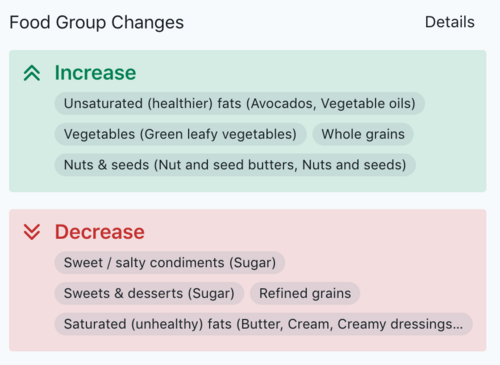
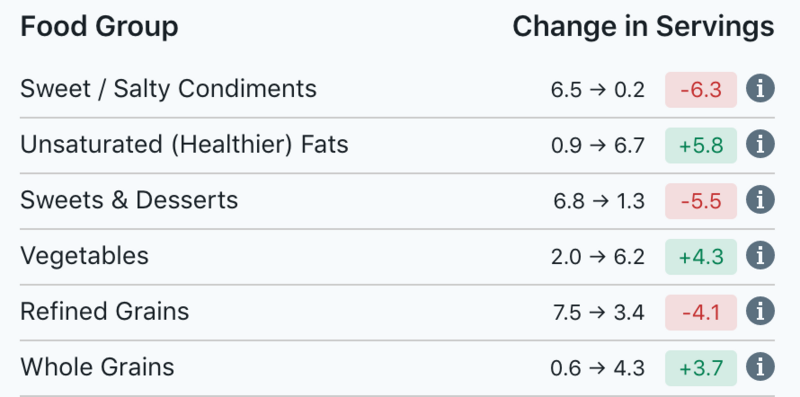
Based on the score, DietID provides a structured plan that identifies:
- Which food groups to increase
- Which to decrease
- How best to transition toward a higher-quality dietary pattern
- Specific, trackable weekly goals
Step 6: Daily and Weekly Tracking Tools
DietID includes:
- Simple, swipe-based daily check-ins
- Short weekly dietary updates
- Goal tracking
- Instant visualization of progress
- Automatic adjustments to your improvement plan
These features allow users to see measurable change across the 90-Day PEL Challenge.
3. Validation Studies: DietID Compared to Traditional Tools
DietID’s visual-pattern method has undergone multiple validation studies comparing it to gold-standard research tools, including:
Food Frequency Questionnaire (FFQ) Validation
In comparative studies:
- DietID demonstrated strong correlations with FFQs in measuring total diet quality.
- Unlike FFQs, DietID had much faster completion times (1–2 minutes vs. 20–40 minutes).
- DietID reduced recall bias because users classify eating patterns rather than recalling foods retrospectively.
- DietID produced more consistent estimates for fiber intake, plant food consumption, and processed food levels—nutrients and categories where FFQs often struggle.
Biometric & Biomarker Correlations
Early implementation studies have shown associations between DietID diet quality scores and:
- BMI
- Blood pressure
- HbA1c
- Lipid profiles
These correlations strengthen confidence that DietID’s scoring reflects meaningful biological differences.
Clinical Use Cases
DietID has been used in:
- Community health interventions
- Employer wellness programs
- Healthcare systems as a “nutritional vital sign”
- Federally qualified health centers
- Insurance and population-health settings
In several case studies, DietID was able to:
- Identify nutritional risk
- Guide personalized dietary improvement plans
- Improve participant engagement
- Demonstrate measurable increases in diet quality over 12–24 weeks
These outcomes are highly relevant to PEL’s mission of transforming individual and population-level dietary patterns.
4. Why DietID Fits Perfectly with the PEL Diet and the 90-Day PEL Challenge
PEL emphasizes diet quality, not calorie counting or restrictive rules. DietID aligns perfectly with this philosophy:
DietID supports the PEL Diet by:
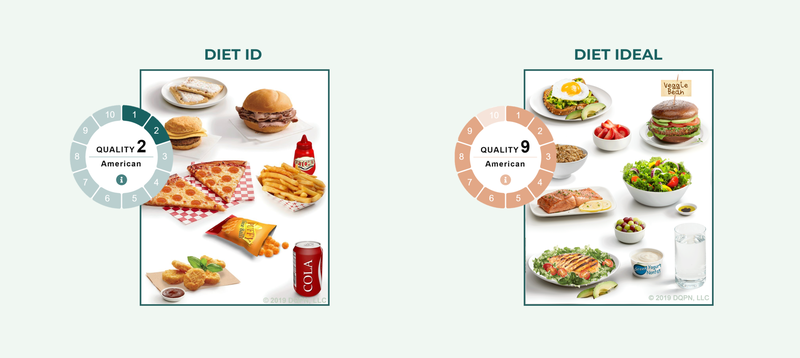
- Measuring baseline diet quality quickly and accurately
- Showing how far someone is from PEL-85 or PEL-100
- Providing a personalized path toward more plant-rich eating
- Reinforcing daily habits that improve long-term health
- Tracking measurable progress throughout the 90-day challenge
- Helping participants celebrate wins and stay motivated
PEL’s science + DietID’s assessment = a powerful combination
- PEL provides the scientific evidence, food guidance, recipes, and tools.
- DietID provides the measurement, monitoring, and progress tracking.
This integration will help individuals, communities, and institutions see that meaningful dietary change is possible—and measurable.
5. What Participants Will Experience During the 90-Day PEL Challenge
Every PEL challenge participant will:
1. Take a DietID assessment at baseline
A 1–2 minute visual assessment that establishes:
- Diet quality
- Plant food intake
- Processed food intake
- Alignment with PEL-85 or PEL-100
2. Receive a personalized improvement roadmap
DietID automatically translates the results into clear, achievable goals.
3. Check in every 2 to 4 weeks
Participants complete simple weekly mini-assessments to track changes.
4. Watch their Diet Quality Score rise
PEL guidance + DietID tracking = momentum, accountability, and measurable change.
5. Complete a final assessment at Day 90
Participants see how far they’ve come—often with double-digit improvements in diet quality.
PEL will use anonymized aggregate data to help refine the program and measure long-term population health impact.
6. A Transformative Tool for Health Systems and Communities
One of the most promising aspects of DietID is its ability to function as a nutritional vital sign in clinics, schools, universities, gyms, and community programs. Because it is fast and does not require food logging or recall, it is scalable in ways traditional nutritional tools are not.
PEL envisions DietID eventually supporting:
- Clinical care partnerships
- Community nutrition interventions
- Workplace wellness programs
- School and university health initiatives
- Public health surveillance
- PEL Activator Projects in low-resource settings
This scalability is one reason PEL selected DietID as a core tool for empowering individuals and communities.
Conclusion: DietID + PEL = Measurable, Meaningful Change
DietID gives individuals a clear picture of their diet quality and a path to improve it. The PEL Diet provides the science, structure, and support needed to make those improvements stick.
Together, they form the backbone of the 90-Day PEL Challenge, enabling anyone—from individuals to entire communities—to transform their health through simple, sustainable dietary change.
References
DietID. Product overview and solution descriptions. https://www.dietid.com/our-solutions
Katz, D.L., et al. Validation publications on Diet Quality Index scoring and visual dietary pattern recognition.
Subar, A.F., et al. (2001–2020). FFQ limitations and recall bias research.
Thompson, F.E., et al. (2021). Dietary assessment validity and technology-based improvements.
Various case studies, DietID Implementation Reports (2020–2024).