
Halting Chronic Disease: The Power of Whole-Food, Plant-Based Nutrition
Introduction: Chronic Disease Is Not Inevitable
For most of human history, chronic diseases—heart disease, diabetes, cancer, dementia—were rare. Today, they account for nearly 75% of global deaths, and most are driven not by genetics, but by lifestyle, especially diet.
A growing body of evidence shows that whole-food, plant-based (WFPB) diets—such as PEL-100 and PEL-85—reduce chronic disease risk and extend healthy lifespan more than any other known dietary pattern.
This conclusion is supported by:
- Landmark interventional studies reversing heart disease
- Decades of epidemiology from the Adventist Health Studies
- The EAT-Lancet Commission
And now, one of the largest pooled analyses ever conducted on healthy aging, published in Nature Medicine in 2025
(Nat Med. 2025; Optimal Dietary Patterns for Healthy Aging).
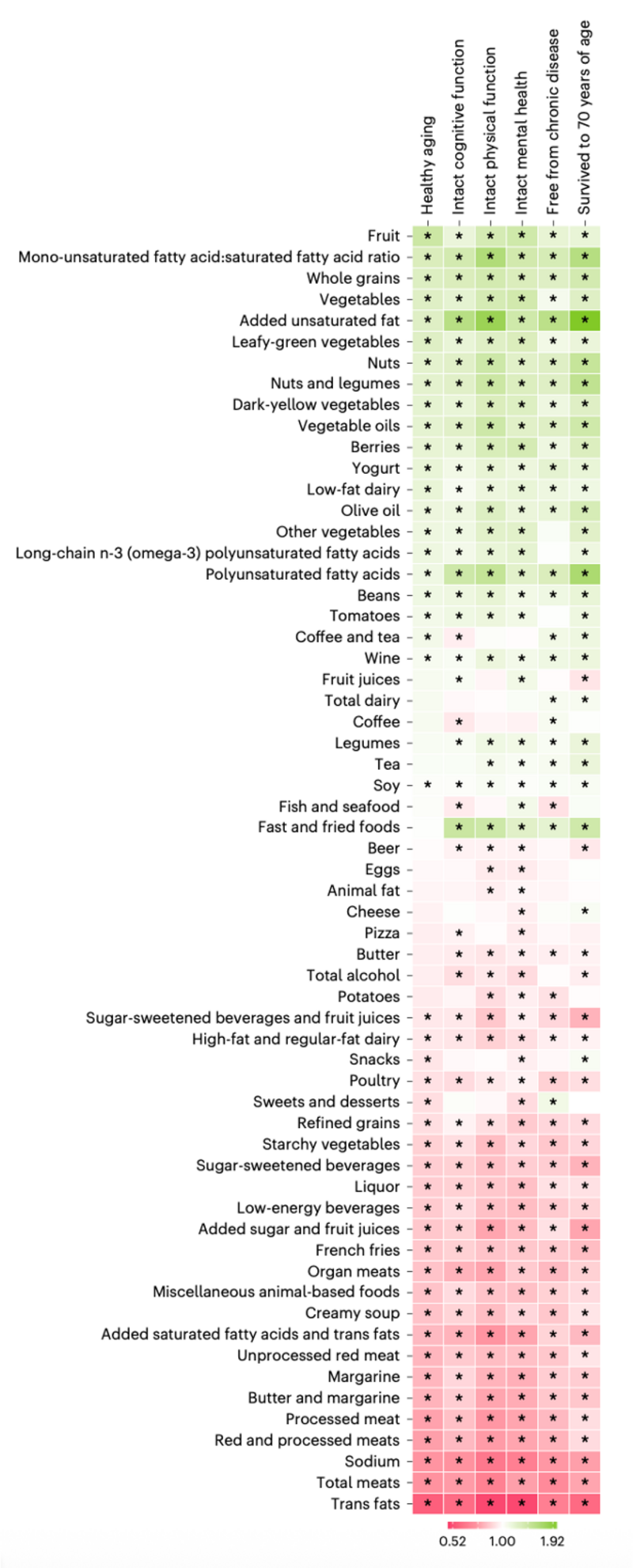
This webpage synthesizes the science and uses Figure 1 from the 2025 study to explain which foods most strongly predict healthier aging, better physical and cognitive function, and freedom from chronic disease.
1. The Landmark Nature Medicine 2025 Study on Healthy Aging
What we eat doesn’t just influence how long we live—it powerfully shapes how well we live as we age. A landmark 2025 study published in Nature Medicine, Optimal Dietary Patterns for Healthy Aging (Tessier et al., 2025), examined eight high-quality dietary patterns in more than 105,000 adults followed for up to three decades.
Rather than focusing on survival alone, the researchers asked a more meaningful question:
Which foods are most strongly associated with healthy aging?
To answer this, they evaluated how specific foods influenced six critical domains of aging:
- Overall healthy aging
- Intact cognitive function
- Preserved physical function
- Good mental health
- Freedom from chronic disease
- Survival to age 70
The study drew on two long-running U.S. cohorts—the Nurses’ Health Study and the Health Professionals Follow-up Study—which together have tracked the diets and health outcomes of doctors, nurses, and other health professionals for decades. This design allowed unusually precise links between long-term diet quality and healthspan, not just lifespan.
The heat map: what foods stack the odds
The figure shown here summarizes one of the study’s most important findings. Using a heat-map visualization, it displays multivariable-adjusted associations between individual food groups and the six domains of healthy aging. Foods shown in green were associated with better outcomes across domains; foods shown in red were associated with worse outcomes.
Foods most positively associated with healthy aging
- Fruits
- Vegetables, including:
- Leafy green vegetables
- Dark-yellow/orange vegetables
- Whole grains
- Nuts
- Legumes (beans, lentils, peas)
- Berries
- Soy foods (tofu, soy milk, edamame)
- Olive oil
- Unsaturated fats (mono- and polyunsaturated, especially from plant sources)
These foods showed broad, consistent positive signals across multiple domains—overall healthy aging, physical function, cognitive function, mental health, and freedom from chronic disease. Together, they form the foundation of the PEL diet.
Foods most negatively associated with healthy aging
- Red and processed meat
- Total meat intake
- High-fat and regular-fat dairy
- Added sugars and sugar-sweetened beverages
- Refined grains
- Trans fats
- High sodium intake
- Organ meats
- Animal fats (butter, margarine)
A note on ultra-processed foods
The study did not model ultra-processed foods (UPFs) as a single category. Instead, it examined individual food groups such as refined grains, sugary beverages, processed meats, French fries, pizza, and snacks.
Although individual foods such as French fries, pizza, and snacks were negatively associated with healthy aging, the composite category of “fried and fast foods” appeared neutral after adjustment. This reflects occasional intake within otherwise high-quality diets. The strongest harms were driven by the core components of ultra-processed diets—processed meats, refined grains, added sugars, sodium, and trans fats—rather than by any single fast-food item.
What about animal foods?
In this analysis, yogurt and low-fat dairy were the only animal-derived foods to show consistently protective associations with healthy aging. However, non-dairy alternatives may offer an even healthier path. Plant-based yogurts (such as soy or cashew yogurt) and protein-fortified plant milks (for example, pea-protein blends) provide many of the same nutritional benefits while remaining naturally low in saturated fat and free from antibiotics and bovine hormones used in modern dairy production. Avoiding these exposures may further stack the odds in favor of long-term health.
How this compares to U.S. dietary guidelines
The latest U.S. dietary guidelines (January 2025) recommend eating patterns that run counter to much of the strongest evidence on healthy aging highlighted in this study. To be fair, the guidelines do get some things right: prioritizing whole plant foods and limiting added sugars and ultra-processed products clearly improves health. This underscores the power of plant-based foods—their benefits are so substantial that they can partially offset, though not erase, the harms of excessive animal-product consumption.
The PEL takeaway
The message for PEL is clear and empowering: longevity and freedom from chronic disease are not matters of chance or genetics alone. The odds of living longer—and staying mentally sharp, physically capable, and disease-free—are strongly shaped by daily food choices.
Diets rich in vegetables, fruits, whole grains, legumes, nuts, and healthy fats consistently stack the odds in our favor, while ultra-processed foods and animal-heavy diets quietly erode them. Across populations and decades of research, the science converges on a simple truth:
Eat more whole plants. Eat them consistently. Let food work as long-term medicine—for people and for the planet.
2. The Heart Disease Evidence: The Strongest Case for the PEL Diets
“There are two types of cardiologists—those who are plant-based, and those who haven’t read the data.”
— Kim Williams, MD, former President, American College of Cardiology
Clinical Trials Showing Reversal of Coronary Artery Disease
Heart disease is the world’s leading cause of death—but it is also the chronic disease with the strongest evidence for reversal through lifestyle change, especially diet. Pioneering clinical work by Dean Ornish, MD and Caldwell Esselstyn, MD showed that whole-food, plant-based (WFPB) diets, when implemented rigorously and sustained, can halt and even reverse coronary artery disease in ways no drug or procedure has matched.
In the Ornish Lifestyle Heart Trial, patients with established coronary disease randomized to an intensive lifestyle program—including a very low-fat WFPB diet, moderate exercise, stress management, and smoking cessation—experienced measurable regression of arterial plaque, reduced angina, and fewer cardiac events, while disease progressed in the usual-care group (Ornish et al., 1990; 1998; 2005).
In parallel, Esselstyn’s long-term clinical studies of patients with advanced heart disease found that those who adhered to a strict WFPB diet had almost no recurrent cardiac events and documented reversal of coronary stenosis, with >99% remaining event-free over more than a decade; nearly all events occurred in non-adherent patients (Esselstyn et al., 1999; 2014).
What makes this evidence unique is its consistency and durability: benefits appeared rapidly, targeted the root cause of atherosclerosis, and extended beyond cholesterol to inflammation, endothelial function, symptoms, and survival.
The PEL takeaway
Whole-food, plant-based diets are not just preventive—they are therapeutic.
PEL-85 captures much of the cardiovascular protection; PEL-100 aligns most closely with the reversal-level interventions used in these landmark studies. Food, chosen wisely and consistently, functions as powerful long-term medicine—capable of halting, and in many cases reversing, the world’s leading cause of death.
No medication or procedure has ever matched the reversal data achieved by predominantly plant-based whole food diets.
This forms the foundation of PEL’s belief: diet is not merely supportive—it is therapeutic.
For more information on the PEL diet and heart disease go to the Science Hub page on Heart Disease.
3. Cancer Prevention and Survival: Fiber, Soy, and Phytochemical-Rich Foods
Fiber-rich plant foods
As described in the PEL Fiber page, diets high in fruits, vegetables, legumes, and whole grains:
- Lower colorectal cancer risk by ~10% per 10 g fiber/day (WCRF/AICR, 2018)
- Lower breast cancer risk by 8–12% per 10 g fiber/day (Aune et al., 2012)
- Improve hormone metabolism and inflammation
Soy and breast cancer outcomes
Across multiple large cohorts, breast cancer survivors consuming the highest soy intake:
- Had 29% lower breast cancer–specific mortality
- Had 36% lower recurrence
(Shu et al., 2009; Zhang et al., 2017)
Plant-based diets and prostate cancer
Ornish’s lifestyle trial showed WFPB diets can slow or reverse early-stage prostate cancer progression, reduce PSA rise, and even change gene expression profiles toward tumor suppression
(Ornish et al., 2005; Ornish et al., 2008).
Figure 1 supports this by showing beneficial associations for:
- vegetables
- whole grains
- legumes
- soy
nuts
and negative associations for foods rich in saturated fats, processed meats, and sugary beverages.
4. Diabetes, Metabolic Disease, and Weight Control
WFPB diets consistently:
- Improve insulin sensitivity
- Reduce fat deposition in muscle and liver
- Reverse early type 2 diabetes
- Support sustained weight loss
(Barnard et al., 2005; Kahleova et al., 2011)
These effects are due to:
- Lower dietary fat
- Higher fiber and water content
- Lower energy density
- Improved microbiome composition
- Reduced inflammation
This matches the Optimal Diets for Healthy Aging (Nat Med 2025) findings, where metabolic health underlies multiple domains of healthy aging.
5. Cognitive Function and Brain Aging
The Nat Med 2025 analysis found strong positive associations between plant-forward foods and intact cognitive function, including:
- Berries
- Leafy greens
- Nuts
- Whole grains
- Olive oil
- Legumes
These findings echo earlier MIND diet studies showing 50% reduction in dementia risk among high adherents (Morris et al., 2015).
The negative associations—red meat, processed foods, trans fats—mirror known mechanisms of:
- neuroinflammation
- vascular damage
- insulin resistance
- oxidative stress
WFPB diets instead promote antioxidant intake, improved vascular function, and reduced beta-amyloid deposition.
6. The Microbiome: The Missing Link
A PEL diet dramatically increases the intake of:
- fiber
- resistant starch
- polyphenols
All of which nourish beneficial bacteria that produce short-chain fatty acids (SCFAs) such as butyrate.
These compounds:
- Improve immune function
- Reduce systemic inflammation
- Strengthen the gut barrier
- Regulate appetite and glucose
- Support healthy aging
(De Filippis et al., 2016; Koh et al., 2016)
The microbiome is one of the key reasons WFPB diets have multi-system benefits.
7. The PEL Diet: A Blueprint for Healthy Aging
The foods that scored highest in Figure 1 are the core of the PEL-100 and PEL-85 Diets:
- Fruits
- Vegetables
- Leafy greens
- Whole grains
- Legumes and soy
- Nuts and seeds
- Olive oil and plant-based unsaturated fats
And the foods most strongly harmful to aging—processed meats, red meats, high-fat dairy, sugary beverages—are minimized or eliminated in PEL dietary models.
The alignment between the Nat Med 2025 study and PEL principles is nearly perfect.
The China Study
In one of the largest and most comprehensive study to be conducted into diet and disease, The China Study showed plant-based diets to be associated with decreased risks of developing cardiovascular disease, cancer, diabetes, and many other diseases.¹
The China–Cornell–Oxford Project (often called the “China Study”) was a massive epidemiological survey across 65 rural counties in China during the early 1980s. Each county was remarkably homogeneous in lifestyle and genetics, which minimized variability from non-diet factors. Researchers collected blood samples, diet surveys, and health outcomes for thousands of adults. They used within-county and between-county comparisons to look at correlations between diet and disease, while controlling for age, sex, smoking, alcohol use, occupation, and socioeconomic factors. Because counties were culturally consistent internally but differed widely in dietary patterns, the study could associate population-level differences in animal vs plant food intake with disease outcomes while reducing confounding from genetics or major lifestyle disparities.
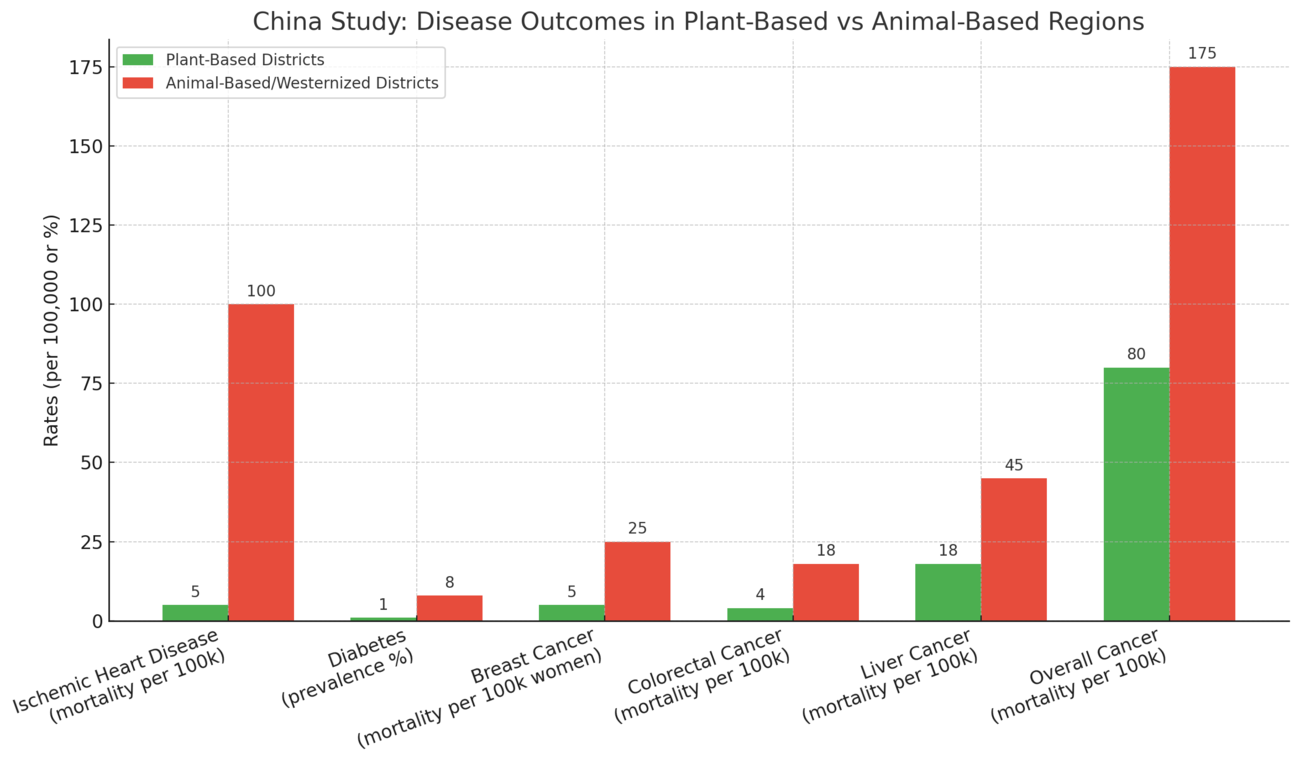
- Cholesterol & disease: A population-wide difference of ~60–80 mg/dL in cholesterol corresponded to 10–20× higher ischemic heart disease deaths.
- Cancer: Breast and colorectal cancer mortality rates were 3–5× higher in high-animal-food counties compared to plant-based ones.
- Diabetes: Almost absent in rural plant-based regions, but increasingly common (≥5–10%) where diets resembled Western intake patterns.
Since the publication of the China Study, and as a direct result of the Global Burden of Disease (GBD, 2019) Study a global scientific consensus has emerged. The two concluded that a worldwide shift to a Planetary Health Diet — rich in whole grains, legumes, fruits, vegetables, nuts, and seeds — could prevent 12 million premature deaths per year while keeping food production within planetary boundaries.² Read more in our webpage on the two EAT–Lancet Commission (2019 and 2025)
Planetary Health Diet Index (PHDI)
More recently, the Planetary Health Diet Index (PHDI) was developed and tested in three of the largest U.S. prospective cohorts (Nurses’ Health Study, Nurses’ Health Study II, Health Professionals Follow-up Study). People with the highest PHDI scores had a 23% lower all-cause mortality, and significantly lower risks of cardiovascular, cancer, respiratory, and neurodegenerative deaths, including alzheimer’s. (Bui, et al., 2024)
This landmark study provides some of the strongest real-world evidence to date that eating in line with the Planetary Health Diet—essentially what we call the PEL-85 diet—is associated with substantially longer life. Researchers followed more than 200,000 adults across three of the most rigorous long-running cohorts in the world (the Nurses’ Health Study, Nurses’ Health Study II, and the Health Professionals Follow-up Study) for up to 34 years. Using repeated dietary assessments, they assigned each participant a Planetary Health Diet Index (PHDI) score that captures how closely a person’s eating pattern aligns with a plant-forward, minimally processed, environmentally sustainable diet. The results were striking: higher adherence consistently translated into lower risk of death from nearly every major cause.
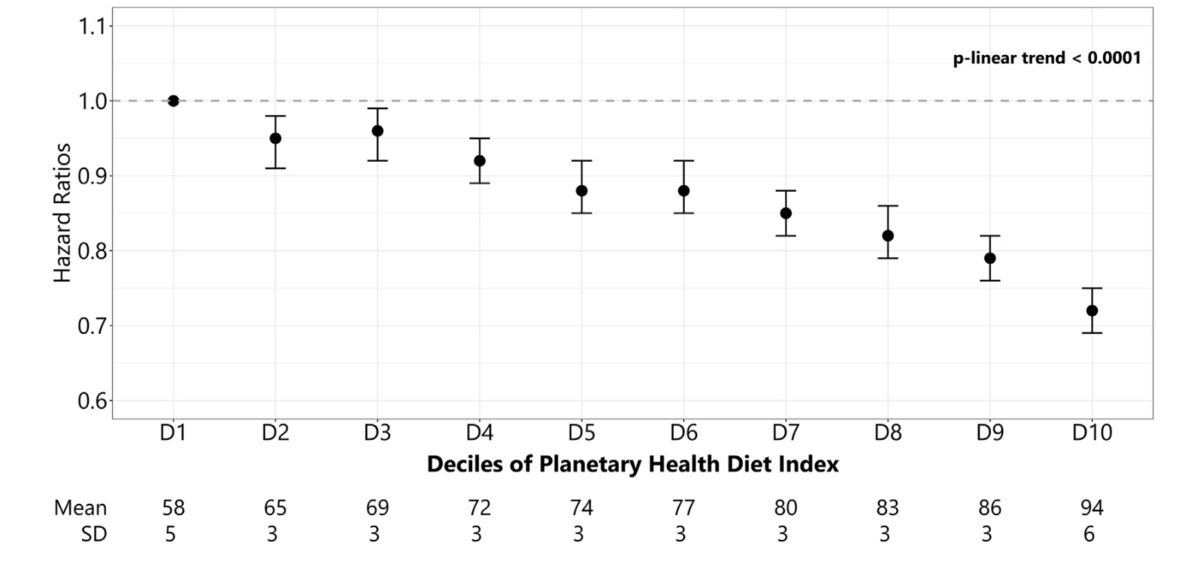
The above Figure shows this relationship clearly and powerfully. As participants moved from the lowest to the highest deciles of the Planetary Health Diet Index, their risk of death steadily declined in a near-linear fashion. Those in the highest decile had approximately a 23–25% lower risk of all-cause mortality compared with those in the lowest decile, even after adjusting for smoking, physical activity, body weight, alcohol use, socioeconomic status, and other major risk factors. This kind of smooth, dose-response gradient—where each step toward a more plant-forward diet confers additional benefit—is a hallmark of robust epidemiologic evidence and strongly supports a causal relationship rather than chance or confounding.
Importantly, the benefits were not limited to one disease. Higher Planetary Health Diet Index scores were associated with lower mortality from cardiovascular disease, cancer, respiratory disease, neurodegenerative disease, and infectious causes. Respiratory mortality showed one of the strongest associations, with nearly a 50% reduction among those most adherent to the diet. These findings underscore a central principle of the Planetary Health Diet and PEL-85: this is not a diet targeting a single organ or diagnosis, but a systems-level intervention that improves metabolic health, immune resilience, vascular function, and inflammatory balance simultaneously.
What makes this study especially powerful is its methodological rigor. Diet was assessed repeatedly over decades, reducing measurement error. Results held across sensitivity analyses, subgroup analyses, and after accounting for other well-known healthy dietary patterns. The authors also demonstrated that higher Planetary Health Diet Index scores were linked to lower environmental impacts, including reduced greenhouse gas emissions and land use—showing that the same dietary pattern that extends human life also protects the planet. Taken together, this evidence strongly supports the idea that the PEL-85 diet is not radical or experimental, but a scientifically validated way of stacking the odds toward longer life, better health, and a more sustainable future.
For Further Education
The China Study — T. Colin Campbell
How Not To Die — Michael Greger, MD
How Not To Diet — Michael Greger, MD
How Not To Age — Michael Greger, MD
Vegan For Life — Jack Norris, RD & Virginia Messina, MPH, RD
The Physicians Committee for Responsible Medicine
Prevent and Reverse Heart Disease — Caldwell Esselstyn, MD
The Proof is in the Plants - Simon Hill
Un-Do It – Dean Ornish and Anne Ornish
Eat to Beat Disease - William W Li
References: The Science That Informs Our Work
Aune, D., et al. (2012). Dietary fiber and breast cancer risk. Ann Oncol.
Barnard, N.D., et al. (2005). A low-fat vegan diet improves glycemic control. Diabetes Care.
Barnard, N.D., et al. (2006). Vegan diet improves glycemic control. Diabetes Care. 29(8):1777–83.
Barnard, N.D., et al. (2009). Vegan diet vs conventional diabetes diet trial. Am J Clin Nutr. 89(5):1588s–96s.
Bui, L.P., Pham T.T., Wang F., et al. (2024). Planetary Health Diet Index and mortality. Am J Clin Nutr. doi:10.1016/j.ajcnut.2024.03.019.
Bui, L.P., et al. (2024). Planetary Health Diet Index and risk of mortality in three prospective cohort studies. Am J Clin Nutr. 119(6):1155–1167.
Campbell, T.C., Campbell, T.M. (2006). The China Study. BenBella Books.
De Filippis, F., et al. (2016). WFPB diets and microbial diversity. Gut.
Esselstyn, C.B., et al. (1995). Arrest and reversal of coronary disease. J Fam Pract. 41(6):560–8.
Esselstyn, C.B., et al. (1999; 2014). Reversal of coronary artery disease.
Ferdowsian, H.R., Barnard, N.D. (2009). Effects of plant-based diets on plasma lipids. Am J Cardiol. 104(7):947–56.
Giovannucci, E., et al. (2003). IGF-1 and disease risk. Cancer Causes Control.
Global Burden of Disease Study 2013. (2014). Lancet. 384(9945):766–781.
Hevia-Larraín, V., et al. (2021). Plant vs animal protein for muscle growth. Sports Med. 51:131–148.
Kahleova, H., et al. (2011). Plant-based diets and insulin sensitivity.
Koh, A., et al. (2016). SCFAs and immune regulation. Cell.
Lee, V., et al. (2015). Community plant-based diabetes education. J Nutr Metab. 2015:236234.
Morris, M.C., et al. (2015). MIND diet and Alzheimer’s risk. Alzheimers Dement. 11(9):1007–1014.
National Health and Medical Research Council. (2013). Australian Dietary Guidelines. Canberra.
Nebl, J., et al. (2019). Plant-based diets and physical performance. Nutrients. 11(1):130.
Nat Med. (2025). Optimal dietary patterns for healthy aging (105,015 participants). Nature Medicine.
Ornish, D., et al. (1990). Lifestyle changes and coronary heart disease. Lancet. 336(8708):129–33.
Ornish, D., et al. (1998; 2005; 2008). Lifestyle interventions and chronic disease reversal.
Ornish, D., et al. (2024). Intensive lifestyle and Alzheimer’s. Alzheimers Res Ther. 16:122.
Shu, X.O., et al. (2009). Soy food intake and breast cancer survival. JAMA.
Tessier, A.J., et al. (2025). Optimal dietary patterns for healthy aging. Nat Med. doi:10.1038/s41591-025-03570-5.
Threapleton, D., et al. (2013). Fiber and cardiovascular health. BMJ.
Tonstad, S., et al. (2009). Vegetarian diets and T2DM risk. Diabetes Care. 32(5):791–6.
Turner-McGrievy, G.M., Barnard, N.D., Scialli, A.R. (2007). Vegan diet vs low-fat diet trial. Obesity. 15(9):2276–81.
WCRF/AICR. (2018). Continuous Update Project on diet and cancer.
Willett, W., Rockström, J., et al. (2019). Food in the Anthropocene: the EAT–Lancet Commission. Lancet. 393:447–492.
Zhang, Y., et al. (2017). Soy intake and recurrence/mortality. Cancer.