
Protein on a Plant-Rich Diet: How Much Do We Need—and Can We Get Enough from Plants?
For decades, we’ve been told that protein must come from animal foods to be “complete,” “high-quality,” or “adequate.”
The science says otherwise.
Experts like Simon Hill (The Proof), Viva Longevity, and NutritionFacts.org have broken down the evidence clearly:
Humans do not need large amounts of protein, and plants provide more than enough—often with major advantages for long-term health.
A mostly or 100% whole-food, plant-based (WFPB) diet not only supplies abundant protein, it delivers it in the cleanest, healthiest form possible—without cholesterol, saturated fat, or pro-inflammatory byproducts associated with animal protein.
This page explains how much protein we actually need, why plant protein is fully adequate (and in many cases superior), and what foods deliver it best.
1. How Much Protein Do We Really Need?
Protein Needs: Minimum vs. Optimal
The global scientific consensus—endorsed by the World Health Organization (WHO) and other international bodies—is that most adults require about 0.8 grams of protein per kilogram of body weight per day (≈ 0.36 g per lb) to prevent deficiency.
However, at Plants Earth Life (PEL), we recommend a higher intake for specific groups—particularly:
- Adults who are exercising regularly (especially strength or resistance training)
- Adults over age 50
- Post-menopausal individuals
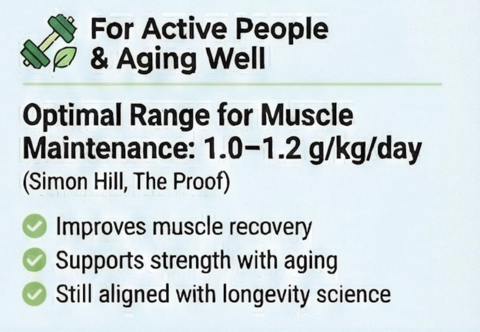
For these groups, evidence supports a target of ~1.2 grams of protein per kilogram per day (≈ 0.54 g per lb) to help preserve muscle mass, support strength gains, and reduce age-related muscle loss (sarcopenia).
What This Means in Real Life
WHO Minimum Recommendation
0.8 g/kg/day (≈ 0.36 g/lb/day)
| Body Weight | Body Weight | Protein / day |
|---|---|---|
| 130 lb | 59 kg | 47 g/day |
| 150 lb | 68 kg | 55 g/day |
| 175 lb | 79 kg | 63 g/day |
| 200 lb | 91 kg | 73 g/day |
PEL Optimal Recommendation (for exercise, menopause, or age >50)
1.2 g/kg/day (≈ 0.54 g/lb/day)
| Body Weight | Body Weight | Protein / day |
|---|---|---|
| 130 lb | 59 kg | 71 g/day |
| 150 lb | 68 kg | 82 g/day |
| 175 lb | 79 kg | 95 g/day |
| 200 lb | 91 kg | 109 g/day |
Why Higher Protein Intakes for Muscle Gain or Healthy Aging?
Simon Hill highlights research showing that when resistance exercise is added, modest increases in protein intake can produce slightly greater muscle gain—with meaningful benefits up to around 1.2 g/kg/day. Beyond that level, the benefits taper off sharply, and most meta-analyses show little to no additional muscle-building advantage above ~1.6 g/kg/day, even in athletes. This is referred to as the “protein ceiling effect.”
Some commentators, including Peter Attia, advocate for higher protein intake—often around 2.0–2.2 g/kg/day—particularly for individuals who want to maximize hypertrophy or are highly trained. However, these recommendations are based largely on small trials, athlete-focused studies, or expert opinion, and are not reflected in the broader scientific consensus. They also run counter to the intake patterns of the longest-lived populations in the world, who thrive on far lower amounts.
Why Not Push Protein Too High?
As Michael Greger, MD (NutritionFacts.org) notes, high protein diets—especially those rich in animal protein—are associated with a number of biological risks, including:
- Elevated IGF-1 levels linked to increased cancer risk
- Increased mTOR activation, accelerating aging pathways
- Higher TMAO production from certain animal proteins, associated with heart disease
- Greater kidney workload and risk for those with underlying kidney issues
Plant proteins do not produce these harmful byproducts, and even at moderately higher intakes (1.0–1.2 g/kg), they remain safe and health-promoting.
Can You Reach This on a Whole-Food Plant-Based Diet?
Yes. According to NutritionFacts.org, people who consume enough calories from whole plant foods almost always meet—or exceed—these protein targets without protein powders or animal products.
Protein-rich plant staples include beans, lentils, tofu, tempeh, soy milk, whole grains, nuts, and seeds, which deliver protein alongside fiber, minerals, and phytonutrients.
As Simon Hill also emphasizes, populations with the greatest longevity (including Blue Zones) typically consume moderate protein intakes (≈10–20% of calories), predominantly from plant sources, a pattern consistently associated with favorable cardiovascular and metabolic outcomes.
Putting It All Together: What’s the Right Number?
- For most adults, 0.8 g/kg/day is fully adequate and aligns with the diets of the healthiest, longest-lived populations.
- For active individuals, older adults, or those wanting to support muscle maintenance, 1.0–1.2 g/kg/day is a scientifically supported target.
- For athletes, small benefits may continue up to 1.6 g/kg/day, but returns diminish.
- Intakes around 2.0–2.2 g/kg/day (as sometimes promoted by Peter Attia) exceed what most research supports and are not necessary for optimal health—including longevity or metabolic goals.
The PEL Diet—centered on whole, minimally processed plant foods—makes it easy to reach any of these evidence-based targets while maximizing long-term health.
2. Do Plant Proteins Provide All Essential Amino Acids?
Yes.
Every plant food contains all nine essential amino acids.
Some simply have higher concentrations than others.
The old myth of “incomplete proteins” was disproven decades ago. As the Academy of Nutrition and Dietetics notes:
“Plant protein can meet all amino acid requirements when caloric needs are met.”
Your body maintains an amino acid pool throughout the day.
You do not need to combine foods at each meal.
Viva Longevity and The Proof both emphasize that legumes—beans, lentils, peas, peanuts, soy—are extraordinarily rich in complete protein and outperform most animal foods in fiber, micronutrients, and longevity benefits.
3. Is Plant Protein as Good—or Even Better?
A growing body of research suggests plant protein may be superior for long-term health:
- Higher plant protein intake is associated with lower all-cause mortality (Song et al., 2016).
- Replacing just 3% of calories from animal protein with plant protein reduces risk of death from cardiovascular disease by 10%, and by 19% when replacing eggs or processed meat (Song et al., 2016).
- Animal protein activates IGF-1 and mTOR pathways linked to cancer growth and accelerated aging (NutritionFacts.org).
- Plant protein sources do not raise IGF-1 to harmful levels and are associated with increased longevity.
Simon Hill notes that plant proteins come packaged with fiber, antioxidants, phytonutrients, and anti-inflammatory compounds—whereas animal proteins come packaged with saturated fat, heme iron, TMAO precursors, and endotoxins.
4. Can You Eat Mostly or 100% WFPB and Easily Meet Your Protein Needs?
Absolutely—and effortlessly.
When you look at the protein density of whole plant foods, the myth of protein deficiency evaporates:
Protein-Rich Whole Plant Foods
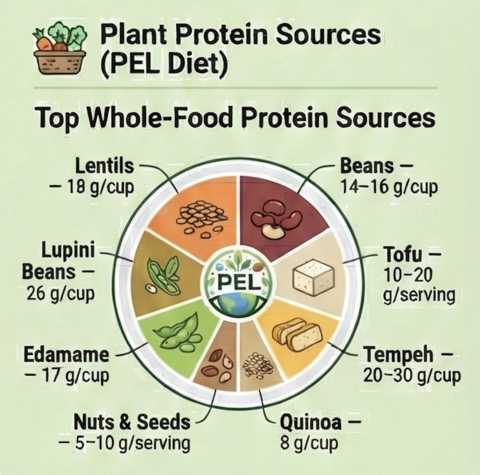
- Lentils: 18 g per cooked cup
- Black beans, kidney beans, chickpeas: 14–16 g per cup
- Tofu: 10–20 g per serving
- Tempeh: 20–30 g per cup
- Edamame: 17 g per cup
- Quinoa: 8 g per cup
- Oats: 6 g per cup
- Peanut butter: 8 g per 2 Tbsp
- Nuts & seeds (hemp, chia, pumpkin, sunflower): 5–10 g per small handful
A single day of PEL-style eating nearly always exceeds the recommended intake:
Example PEL Day
- Oats + soy milk + chia + fruit (12 g)
- Lentil soup (18 g)
- Tofu stir-fry with vegetables (20 g)
- Chickpea salad wrap (15 g)
- Nuts/seeds snacks (6–8 g)
Total: 65–75 grams of protein
—more than enough for most adults.
5. What About Athletes, Older Adults, or Higher Needs?
Simon Hill, The Proof, and NutritionFacts.org all highlight research showing that:
- Athletes can build equal or greater muscle mass on plant-based diets
- Older adults may benefit from higher intakes (1.0–1.2 g/kg), easily achievable with legumes, tofu, tempeh, and whole grains
- Endurance athletes often report improved recovery due to lower inflammation on plant-based diets
Even at higher targets, meeting protein needs through plants is straightforward and often easier on digestion, kidneys, and vascular health.
6. Why the PEL Diet Meets Protein Needs Perfectly
The PEL Diet emphasizes:
- Legumes (beans, lentils, peas, soy)
- Whole grains
- Nuts and seeds
- Leafy greens and cruciferous vegetables
- Fruits and starchy vegetables
This pattern mirrors diets associated with:
- The longest life expectancy
- The lowest chronic disease rates
- The greatest reduction in premature mortality
And it delivers steady, health-promoting protein throughout the day with no downside.
There is simply no biological requirement for animal protein.
Conclusion: Plants Provide All the Protein We Need—And They Do It Better
The science is clear:
- You can easily meet all your protein requirements on a mostly or 100% WFPB diet.
- Plant protein is complete, abundant, and associated with longer life and lower disease risk.
- The foods richest in plant protein are among the healthiest foods ever studied.
A plant-forward PEL Diet doesn’t just meet your protein needs—
it nourishes your body in ways animal protein never can.
References
Websites & Expert Sources
- The Proof with Simon Hill. https://theproof.com/
- Viva Longevity (YouTube). Plant protein & longevity science videos.
- NutritionFacts.org – Michael Greger, MD. https://nutritionfacts.org/
Scientific References
- Song, M. et al. (2016). “Replacing Animal Protein With Plant Protein and Mortality.” JAMA Internal Medicine.
- WHO/FAO/UNU. (2007). Protein and Amino Acid Requirements in Human Nutrition.
- Levine, M. et al. (2014). “Low Protein Intake Is Associated With Major Reductions in IGF-1, Cancer, and Overall Mortality.”
- Satija, A. et al. (2017). “Plant-Based Diets and Cardiovascular Health.” Journal of the American College of Cardiology.
- Richter, C. et al. (2021). “Plant Protein and Muscle Protein Synthesis.”
- Craddock, J. et al. (2017). “A systematic review of plant-based diets for athletes.”